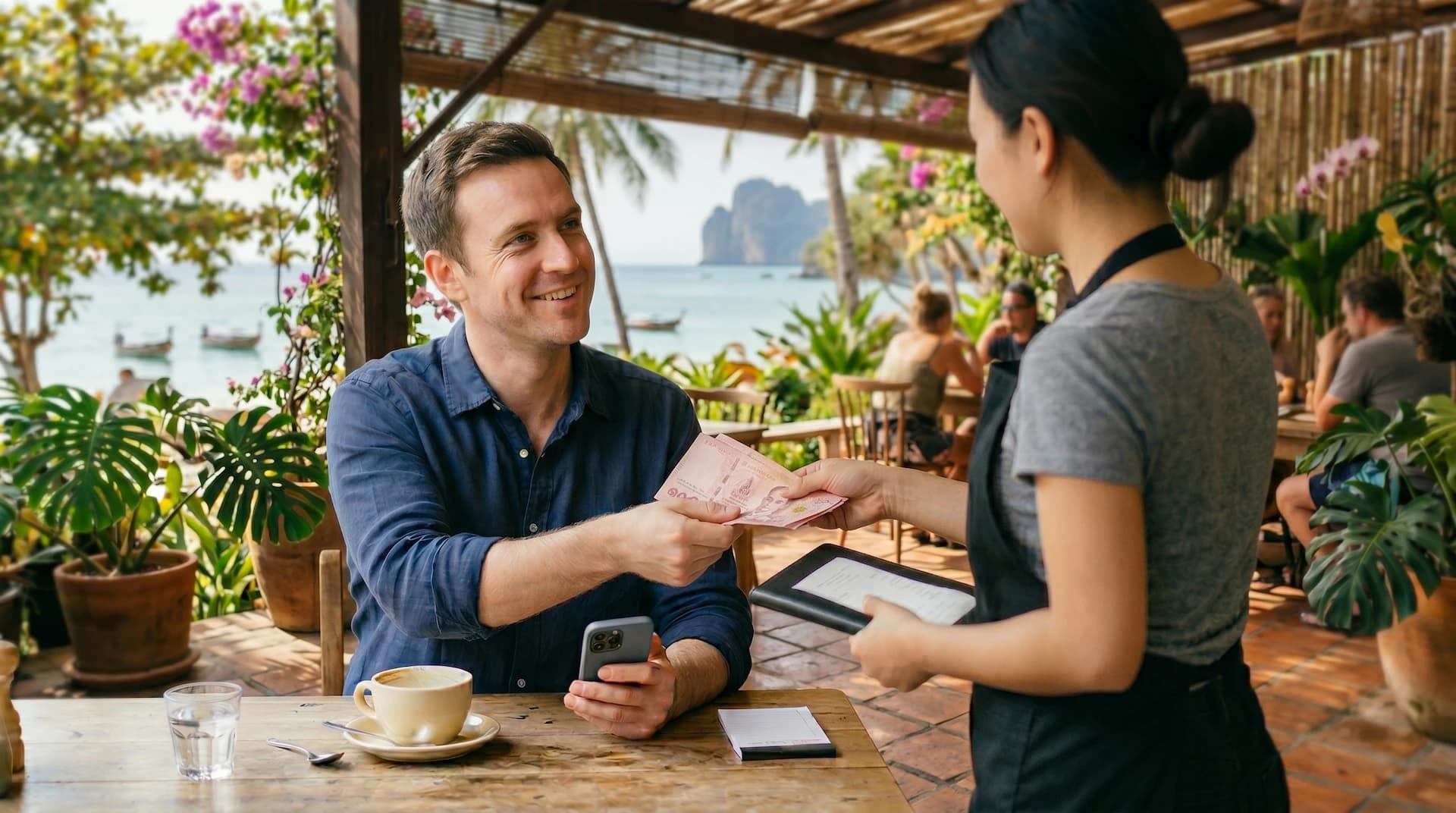
The Expense Tracker Built for the Digital Nomad Lifestyle
SpendSnap is a digital nomad expense tracker for people who earn remotely and spend across borders. Log every expense in the currency you paid in — 160+ supported — set a monthly budget, and track your pace in real time. Works offline, requires no bank account, and starts in under a minute.
Last updated
Free to try • iPhone only • No account required
Why Most Expense Apps Fail Digital Nomads
Expense apps are mostly built with one assumption: you live in one country, earn in one currency, and spend through one or two bank accounts. Digital nomads break every part of that assumption.
The gaps show up quickly:
- Bank sync is geographically limited. Aggregators like Plaid and TrueLayer have strong coverage in the US and UK, and patchy or nonexistent coverage in Southeast Asia, Latin America, Eastern Europe, and most of Africa — exactly where nomads tend to go.
- Cash is invisible to automated trackers. Street food in Chiang Mai, a tuk-tuk in Bangkok, a guesthouse in Tbilisi — cash is often the only option, and none of it appears in an automated bank feed.
- Multi-currency is an afterthought. Many apps assume a single base currency at setup and make it awkward to change mid-year as you move between countries.
- They require reliable internet. Apps built around live data sync become unreliable on long-haul flights, remote co-working spots, or SIM-switching days between countries.
- Setup friction is too high. Linking foreign bank accounts, setting up new currency profiles, re-entering FX settings — the overhead compounds every time you move.
The result is most nomads either track inconsistently, abandon tracking entirely, or fall back on spreadsheets. None of those give you real-time awareness of whether your spending matches your income and goals.
What a Digital Nomad Actually Needs from an Expense Tracker
After identifying what breaks, the requirements for a nomad-grade expense tracker become clear:
- Multi-currency logging at the point of purchase — enter the exact amount in the currency you paid, including THB, IDR, EUR, MXN, or any of the 160+ others
- Offline-first operation — full functionality without internet; data syncs when connectivity returns
- Cash as a first-class expense type — no friction difference between logging a cash meal and a card hotel booking
- No mandatory bank linking — useful from day one without needing to connect any financial accounts
- Fast entry — logging while standing at a street food stall, on a bus, or in a taxi needs to take seconds, not minutes
- A monthly budget target — nomads need to know if their burn rate is on track relative to a target, not just see a list of transactions
- Data portability — the ability to export your data and take it with you, regardless of platform
SpendSnap is designed specifically around this list.
How SpendSnap Fits the Digital Nomad Lifestyle
SpendSnap was built from the ground up for mobile, multi-currency, cash-heavy spending. It doesn't try to do everything; it does the things that actually matter for life on the move.
- Log in any currency, instantly. When you pay for something in a local currency, you log it in that currency — exactly as the receipt shows. SpendSnap handles conversion to your home currency automatically, using FX rates refreshed daily when you're online.
- Works completely offline. No internet? No problem. You can log every expense on a 14-hour flight, in a remote mountain town, or while switching SIM cards between countries. Everything syncs cleanly when you reconnect.
- Track cash spending. Add any cash expense in seconds — same interface, same speed as a card entry. Nothing slips through because it wasn't on a card.
- Monthly budget pacing. Set a target monthly spend, and SpendSnap shows you in real time whether you're ahead or behind your pace — so you can adjust before the end of the month, not after.
- No bank linking required. No credential sharing, no aggregator setup, no coverage gaps. It works the same way in Bangkok as it does in Berlin.
- Export anytime. Your full expense history exports to CSV. Take it, analyze it in a spreadsheet, use it for tax purposes, or just keep it as a record.
Free to try • iPhone only • No account required
Managing Money Across Popular Nomad Destinations
Every nomad hub has its own financial quirks. A few patterns worth knowing:
Southeast Asia (Thailand, Indonesia, Vietnam, Cambodia)
Cash is dominant in daily life — street food, local transport, markets, smaller guesthouses. Cards work at malls, larger hotels, and tourist areas, but expecting card-only to cover your spending is unrealistic. THB, IDR, VND, and KHR are all supported in SpendSnap.
Europe (Portugal, Georgia, Estonia, Czech Republic)
More card-friendly overall, but cash remains common in smaller towns, local restaurants, and markets. Multi-currency complexity peaks here for nomads holding EUR, GEL, or CZK alongside a home currency.
Latin America (Mexico, Colombia, Argentina)
Cash is essential in Mexico City's local markets, Medellín's everyday transactions, and almost everywhere in Argentina, where informal exchange rates create additional complexity worth tracking separately. MXN, COP, and ARS are all supported.
Middle East & North Africa (UAE, Morocco, Egypt)
Mix of card infrastructure in cities and heavily cash-based economies outside tourist areas. Logging in AED, MAD, or EGP at point of purchase keeps your records accurate.
The common thread across all of these: if you're relying on bank sync alone, you're missing large portions of your actual daily spend.
Building a Simple Nomad Expense System with SpendSnap
Expense tracking only works if the habit sticks. A few practices that make it sustainable on the road:
- Log at the moment you pay. The single biggest habit that separates consistent trackers from inconsistent ones. Doing it immediately takes five seconds and requires no memory. Doing it later requires reconstructing your day.
- Set your base currency to your income currency. If you earn in USD, GBP, or EUR, set that as your home currency in SpendSnap. All conversions flow into that number, making monthly totals immediately meaningful relative to your income.
- Create a category for currency exchange costs. Every time you withdraw cash or convert money, log the fee or spread as its own expense. Over a year of nomadding, these costs are often surprisingly high and worth tracking separately.
- Check your monthly pace weekly, not daily. Day-to-day totals fluctuate with FX rates and irregular spending (a flight here, a hotel deposit there). A weekly check of your monthly pace gives you actionable signal without noise.
- Export at the end of each country or major leg. A CSV export at natural trip breakpoints — leaving Bali, finishing a month in Lisbon — gives you a clean record of that phase. Useful for budgeting future trips to the same destination and for any tax requirements in your home country.
- Use quick-add presets for recurring spending. SpendSnap lets you set up shortcuts for frequent expense types. A recurring coworking day pass, a weekly grocery run, a regular coffee order — one tap instead of re-entering every time.
Frequently asked questions
Keep exploring
- How to budget for a trip
- Expense tracker template
- How to avoid foreign transaction fees
- Best currency converter apps
- Best expense tracker app
- How to track expenses while traveling
- Thailand trip cost
- Japan travel budget
- Bali travel budget
- Nicaragua travel budget
- Vietnam travel budget
- Costa Rica travel budget
- Peru trip cost
- Mexico travel budget
- Philippines travel budget
- Cost of living in Thailand
- Cost of living in Vietnam
- Cost of living in Bali
- How much cash to bring to Japan
- Cash envelope system
- Travel budget template
- Travel expense tracker
- Multi-currency expense tracker
- Expense tracker without bank account
- Manual expense tracking vs bank sync
- Expense tracker for travelers
- Travel budget app
Free to try • iPhone only • No account required